Last updated: 11 October 2026, 10.10am BST.
UK robotics adoption hubs will receive £40 million in backing announced by the government on 9 October 2026, with eight hubs intended to help organisations assess and introduce automation. A University of Bristol announcement on 10 October adds a concrete example: a £9.8 million South West hub expected to be fully operational by January 2027.
UK robotics adoption hubs: what is actually new?
The government announcement identifies support spanning areas including surgery, agriculture, manufacturing and waste. The proposed value is access to advice, demonstrations and help with adoption, rather than requiring each potential user to develop that expertise alone.
That is an ambition, not evidence that a particular hospital, farm or business has already delivered the promised improvement. No Sussex organisation is identified here as having received a specific allocation.
One hub makes the funding clearer
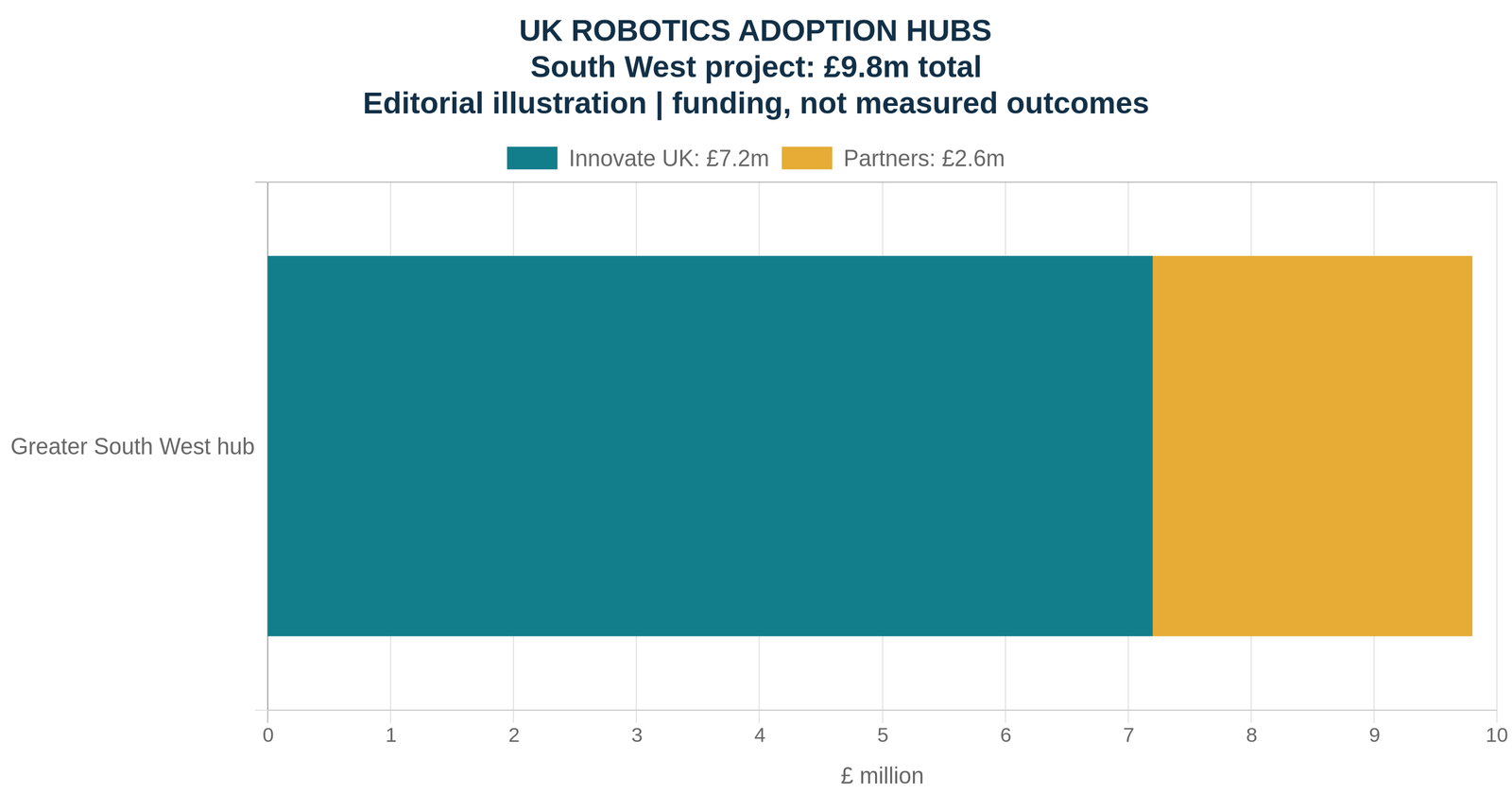
The University of Bristol’s 10 October announcement describes a consortium of 23 partners led by Bristol Robotics Laboratory, with UWE Bristol and NCC. Its £9.8m total includes £2.6m from project partners alongside £7.2m Innovate UK funding.
Bristol expects the Greater South West hub to be fully operational by January 2027. Its advertised offer includes advice, opportunities to see systems working, and connections between adopters and suppliers. UWE Bristol’s account, published on 9 October, corroborates the project and funding composition.
Why the national totals differ
UKRI’s programme page gives £52m for the wider programme over April 2026–March 2030. Meanwhile, the original hub competition stated a £38m fund and an application deadline of 15 April 2026.
A competition ceiling, the subsequent government announcement and a wider multi-year programme are different descriptions. Reading them as three additive pots would inflate the support available.
What Sussex businesses should do
Use UKRI’s programme page to establish the scope before pursuing support. Do not treat the closed hub competition as a current grant offer, or assume a South West service automatically covers Sussex. Check the relevant hub’s geographical remit, access arrangements and opening date as delivery information becomes available.
Before contacting an adviser, describe the task you want to improve, the current cost and the operational constraints. Ask about integration, staff training, safety and maintenance as well as the robot itself. These are our practical assessment questions, not announced eligibility conditions.
Brighton Locals’ view
Editorial judgement: Shared advice and demonstrations are a sensible response to the difficulty of judging unfamiliar technology. The important test is whether organisations can obtain usable, impartial help and demonstrate improvements after adoption. Funding announcements alone cannot establish faster recovery, better harvests or a return on investment.
What to watch next
Watch for confirmed service access, delivery dates and evidence of results. For the South West example, January 2027 is the stated operational target. Specific Sussex access and local beneficiaries remain unconfirmed in the evidence reviewed.
Bottom line
The new hubs aim to make robotics easier to assess and adopt. Businesses still need a clear route into the service and a credible case for the individual investment.
Featured image: Editorial illustration by Brighton Locals using the University of Bristol’s published funding figures. It shows the South West project’s composition, not national allocations or measured outcomes.

Leave a Reply