Last updated: 16 October 2026, 23:45 BST.
A Brighton rain forecast can show a percentage without telling you how long a shower will last. Understanding that distinction helps when deciding whether to carry a coat, change a seafront walk or make a backup plan for an outdoor activity.
This is an explainer checked on 16 October 2026, not a new forecast or weather warning. The 40% figure below is an illustrative example, not a prediction for Brighton today.
Brighton rain forecast: reading the percentage
In its explanation of probability forecasting, published on 3 February 2026, the Met Office describes app percentages as the chance of rain in a particular hour or day. That February explanation is background, not a newly issued October forecast.
If a forecast assigns a 40% chance to rain at a named location over a stated period, it describes how likely that event is. It does not mean rain for 40% of the period, nor that exactly 40% of Brighton will get wet. It also does not specify an amount in millimetres.
Think of probability as information about uncertainty. A number below 50% is not a promise of dry weather, just as a number above 50% is not a guarantee that rain will occur.
Why one dry afternoon does not settle forecast quality
The Met Office’s decision-making guide explains that forecast models explore different possible outcomes. It assesses probabilities across many forecasts, rather than calling a single probability right or wrong after one outcome.
In our illustrative 40% example, a dry outcome remains possible. That is not a loophole invented after the event: the chance of the event not happening is already part of the forecast. Equally, rain would not prove that a probabilistic forecast was somehow secretly a certainty.
The useful question is whether probabilities are well calibrated across repeated forecasts. One wet school run cannot answer that by itself.
Check the time window, not just the largest number
For a morning journey and an evening walk, inspect the relevant periods separately. An hour-specific figure is not automatically a whole-day figure. Nor should successive hourly percentages simply be added together: the weather in neighbouring hours is not a collection of unrelated events.
The Met Office’s forecast-timescale guide also distinguishes detailed short-range information from broader outlooks. It says even a one- or two-day forecast cannot pinpoint every localised shower or fog patch. A general outlook many days ahead should not be turned into a precise promise about one street.
What residents should do with the information
Choose the place and the hours you will actually be outside. Read the forecast description as well as the percentage, and check the official warning page separately. A rain probability is not a warning category.
Then consider the cost of being caught out. Carrying a light waterproof is a smaller change than cancelling an organised outdoor event. Someone protecting equipment may reasonably take precautions at a lower probability than someone deciding whether to walk a few minutes to a café. Those are different decisions, not different readings of the same number.
Brighton Locals’ view
The best use of uncertainty is proportionate preparation. We would not advise cancelling a day out solely because an app shows our hypothetical 40%, or ignoring it because dry weather is more likely. Look at timing, the wider conditions and the consequences for your particular plan.
What to watch next
Recheck the latest forecast before setting out, especially if the plan depends on a narrow dry window. Our separate Hove weekend weather report for 17–18 October is dated forecast coverage; this page explains how to read such information.
Bottom line: a rain percentage is a measure of chance, not a timetable for getting wet.
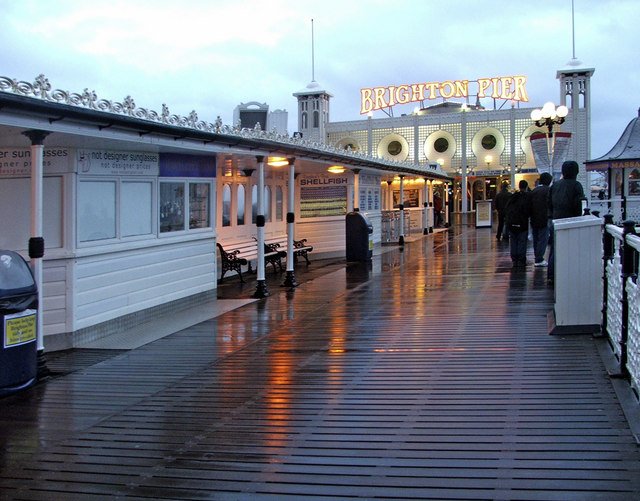
Featured photograph: Brighton Pier on a wet day, 6 November 2005. Archive photograph, not current conditions or a forecast. Photo: Christine Matthews / Geograph via Wikimedia Commons, CC BY-SA 2.0. No editorial alterations.


Join the conversation