Last updated: 14 October 2026, 1.08am BST.
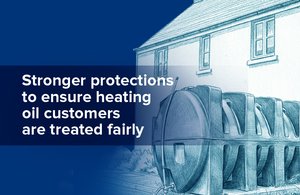
Featured image: Official government heating oil consumer-protection policy graphic, published 13 October 2026. Source: Department for Energy Security and Net Zero / GOV.UK. Crown copyright, Open Government Licence v3.0. Not a photograph of a Sussex property.
Heating oil consumer protections are set for reform after the UK government accepted the Competition and Markets Authority’s recommendation for stronger regulation on 13 October 2026. The immediate distinction for households is that a new regulatory regime is being developed: the announcement does not say a complete set of new rules has already taken effect.
Heating oil consumer protections: what changed?
The Department for Energy Security and Net Zero announcement commits ministers to developing a regulatory regime with industry. It also promises shorter-term work on codes of conduct and a review of practices that require some customers to buy at least 500 litres. A review is not confirmation that every supplier’s minimum has changed.
The formal government response explains the underlying problem: heating oil is bought in separate deliveries, outside the continuously connected supply and licensing arrangements used for retail gas and electricity. Customers need clarity on quotations, cancellations, vulnerable-customer support and complaints when the market is under strain.
What the CMA found earlier this year
In its 15 July findings, the CMA said about 1.5 million UK households depended on heating oil. Around 1,700 customers were affected by possible contractual breaches when orders were cancelled; some paid £150–£350 more for replacement fuel.
The regulator said a number of suppliers had agreed to compensate people who paid more to replace cancelled orders, or honour the original order where replacement fuel had not been bought. It also said not all affected suppliers had agreed. Those are specific findings from July, providing context for this week’s policy response, rather than a newly discovered group of cases.
Why this matters in Sussex
The reform is relevant to rural and off-gas-grid households, including those in Sussex that heat with oil. This report does not establish how many local homes are affected or whether a particular Sussex supplier was involved. The practical issue is the same wherever a household lives: a refund can leave someone facing a much higher replacement bill if the original delivery is cancelled.
What you should do about a cancelled order
Keep the original order confirmation, quoted price, payment record, cancellation message and any replacement invoice. If the circumstances match the CMA’s cases, ask the supplier in writing whether your order was included in its compensation arrangements and how it calculated any payment. The CMA’s case page links its completed study and original findings.
These are record-keeping steps based on the published intervention, not a finding that an individual customer is legally entitled to a particular sum. The new announcement should not be read as an instruction to stop paying for or ordering necessary fuel.
Brighton Locals’ view
Accepting the need for regulation is a useful step. The test is whether the eventual rules make an agreed order dependable and a complaint practical to resolve. A compensation route that exists on paper but is difficult to use would leave the central problem intact. The review of minimum volumes also deserves attention, since the upfront bill can be significant even before prices rise.
What to watch next
Look for the detailed regulatory proposals, the revised industry code and implementation dates. Those will show what customers can actually enforce and when. The policy response is the next official reference point; a promise to develop rules should remain clearly separated from rules already in force.
The direction is towards stronger protection; households still need the delivery details and a workable route to redress.

Leave a Reply