Last updated: 16 October 2026, 00:56 BST.
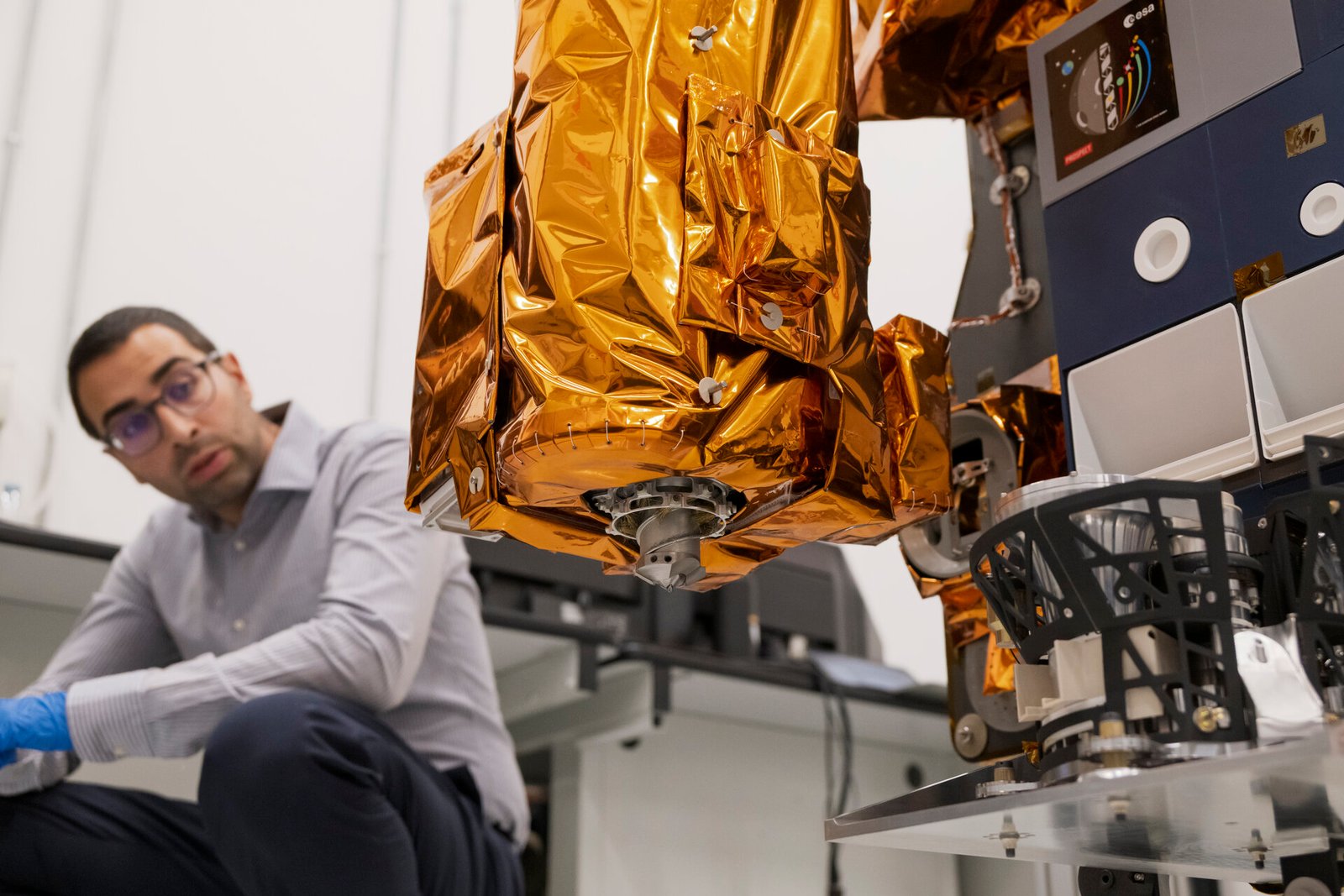
Photograph released 15 October 2026: Christian Panza observes an ESA Prospect drill deployment test on Earth. Test date not specified. Photo © ESA–A. Conigli. Source: ESA; reused for editorial reporting under the ESA Standard Licence. Resized for display.
The ESA Prospect lunar drill has been shown deployed from a test panel on Earth in a photograph released by the European Space Agency on 15 October 2026. The equipment is being prepared for a 2027 mission to investigate possible water ice near the Moon’s south pole.
What is new about the ESA Prospect lunar drill?
The 15 October release documents deployment from a panel similar to the intended flight mounting. ESA does not date the photographed test in that release. Publication of the image should therefore not be read as proof that the test happened on 15 October, or that the payload is already flight-ready.
The next task is scientific as well as mechanical. Prospect is intended to collect material beneath the surface, preserve it for analysis and heat samples in a miniature laboratory to almost 1,000°C. Measurements of the released gases can help establish what volatile substances are present.
Why a drill and a laboratory need each other
ESA’s earlier mission explanation, published in August 2024, distinguishes ProSEED, the drilling and sampling system, from ProSPA, the analysis package. Leonardo leads the former; the Open University leads development of the latter.
The laboratory uses sealed ovens to release and measure gases. That gives the drill’s physical sample a scientific purpose: measuring composition and abundance, rather than merely demonstrating that a hole can be made.
The June 2026 mission briefing describes operations over approximately ten Earth days during one lunar day. It also outlines a test of processes relevant to extracting oxygen from lunar material. Those are planned investigations, not evidence that a usable resource has already been found.
The UK connection and the limits
The Open University’s role makes this a British instrumentation story within a European and US mission. ESA identifies Nova-C as the landing platform and NASA’s Commercial Lunar Payload Services initiative as the delivery framework. The 2027 target does not provide a confirmed launch day or guarantee a successful landing.
Hardware deployment, survival during flight, landing, sampling and measurement are separate hurdles. A successful terrestrial test is useful evidence about preparation; it cannot answer the questions the instruments are being sent to investigate.
Brighton Locals’ view
The valuable advance is the link between collecting a sample and analysing it with a compact laboratory. Our assessment remains cautiously positive: practical hardware progress deserves attention, while claims about supplying future explorers need actual measurements of accessible material and its concentration.
What to watch next
Follow the linked ESA mission briefings for integration updates, a firmer flight timetable and subsequent sampling results. Readers comparing lunar technologies can also see our report on cold-tested NASA batteries, another case where a laboratory result and a complete mission capability require different evidence.
Prospect’s next achievement must be more than reaching the Moon: it needs to return measurements that make the material beneath its surface better understood.

Leave a Reply