Last updated: 15 October 2026, 23:27 BST. The underlying research update was published by NASA on 14 October, not announced as breaking news tonight.
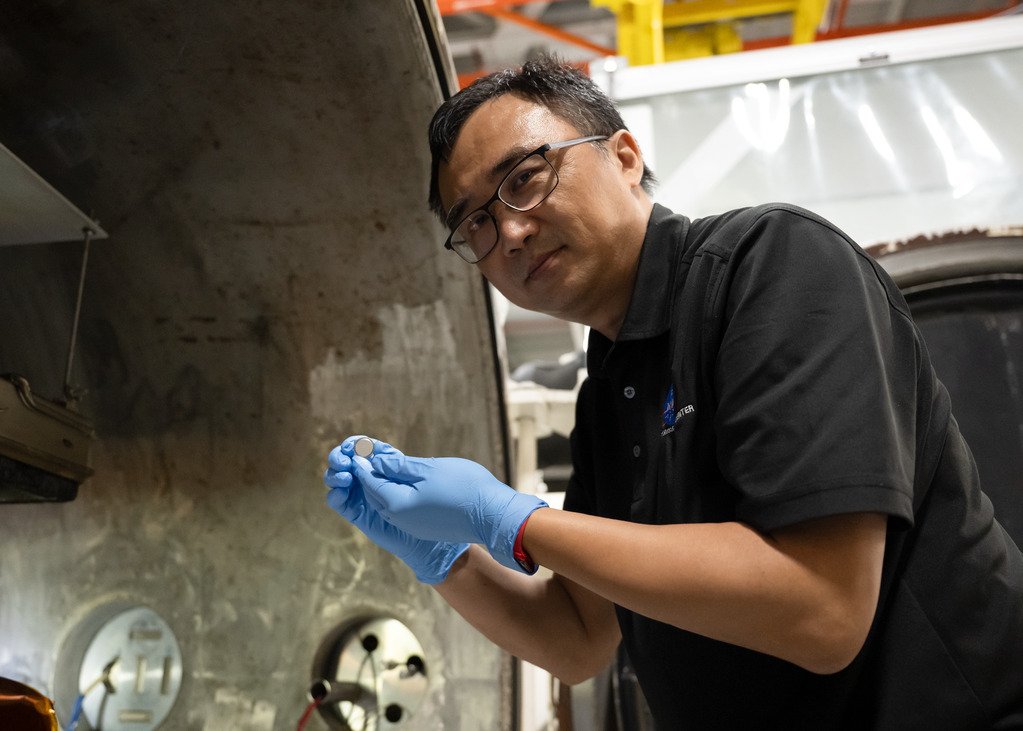
Yi Lin with a SPEARS coin-cell battery after thermal vacuum testing at NASA Langley. Published by NASA on 14 October 2026. Photo: NASA / Ryan Hill. Used for factual editorial reporting under NASA’s media usage guidelines; no endorsement implied. Resized for display.
NASA SPEARS batteries operated at −80°C with reduced performance in ground tests at Langley Research Center in Hampton, Virginia, the agency reported on 14 October 2026. The result concerns small prototype cells, with a crucial qualification: surviving colder conditions does not mean delivering electricity at those temperatures.
NASA SPEARS batteries: what the tests showed
According to NASA’s research update, the cells performed well between −60°C and 80°C. They continued working at −80°C, but with slightly reduced performance.
A separate exposure result found no damage after temperatures between −170°C and 100°C. NASA explicitly says the cells cannot operate while at −170°C. Small heaters would bring them back into their working range when power is needed.
SPEARS replaces a liquid electrolyte with a solid ceramic- or polymer-based material. Its proposed advantage is reducing the need to keep a battery warm continuously.
Why this is still a research result
A useful battery is a complete system, rather than a temperature headline. For any eventual application, the energy spent warming the cells has to be considered alongside the electricity they can then supply.
The published account does not quantify capacity, charge-cycle life or the heating-energy requirement. Those missing measures limit comparisons with batteries already used in equipment. The absence of those figures is not evidence that performance is poor; it is a reason to avoid making a performance claim the data cannot support.
NASA’s technical archive also lists a presentation on materials challenges in aerospace solid-state batteries for the April 2026 Space Power Workshop. It is catalogued as a presentation, rather than a peer-reviewed journal article, and should be read in that form.
What readers should look for next
When comparing future announcements, ask for the operating temperature, cell size, delivered capacity, repeated-use performance and energy needed to restart after cold exposure. A survival figure alone answers only part of that list.
Phys.org also carries the report, credited to NASA. That is a republication of the agency’s account, rather than independent experimental confirmation.
Brighton Locals’ view
This is promising progress towards equipment that can be left cold and warmed when required. The sensible next test is whether that approach produces a worthwhile benefit at battery-pack level. It is too early to translate a laboratory temperature result into a claim about a future phone, car or flight-ready lunar system.
For separate space-research coverage, read our ISS research mission report.
The bottom line: the prototypes have demonstrated useful cold operation; the full energy and durability case still needs evidence.

Leave a Reply