Last updated: 14 October 2026, 3.28am BST.
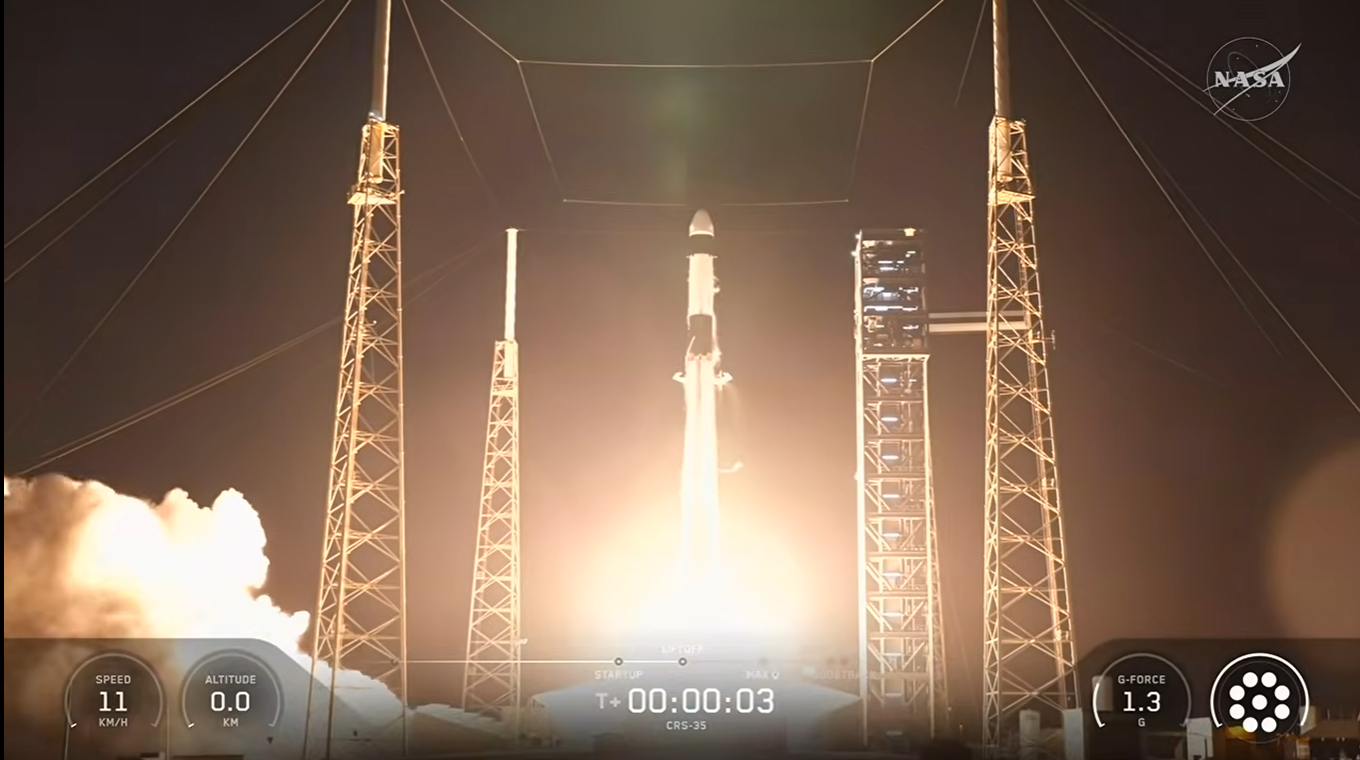
NASA’s launch-broadcast still of the SpaceX CRS-35 launch at Cape Canaveral, Florida, 13 October 2026. Credit: NASA. Used for factual editorial reporting under NASA’s image and media guidelines; no NASA endorsement is implied. WordPress supplies resized versions.
SpaceX CRS-35 launched from Cape Canaveral, Florida, on 13 October 2026 with research equipment, supplies and the final pair of new roll-out solar arrays for the International Space Station. NASA’s confirmed launch report moves the story beyond a proposed launch date: the spacecraft is in flight, while docking and the experiments themselves remain ahead.
In short
- Falcon 9 lifted off at 6.33am EDT on 13 October, equivalent to 11.33am BST.
- The cargo total exceeds 6,300 pounds, according to NASA.
- Dragon is scheduled to dock on Thursday 15 October at 4pm BST.
- Brain models and other experiments are research, not approved treatments.
What SpaceX CRS-35 is carrying
NASA’s 13 October launch release confirms the flight from Space Launch Complex 40. It says the solar arrays will complete the station’s power-system augmentation; installation is planned during spacewalks later this autumn. A successful cargo launch is therefore not the same milestone as having the equipment installed and working.
NASA’s separate science briefing, published on 12 October and updated on 13 October, explains the health research. Small laboratory-grown brain models will spend five weeks in space and be compared with matched models kept on Earth. The purpose is to investigate cellular responses, not to recreate a whole person’s brain or establish a treatment through a launch alone.
Other investigations address crop disease, measurements of biological markers and drug-resistant bacteria. One tests a compact microplate reader’s ability to analyse samples on the station rather than waiting for their return to Earth. Another studies how resistant organisms behave in microgravity. These are described research aims; results have not yet been demonstrated by this mission.
Why the distinction matters
There are several separate tests here: transport the hardware safely, commission it, gather useful data and show that the findings hold up. A claim about eventual benefit to patients needs more evidence than a successful rocket flight. Our report on UK quantum sensing funding makes the same distinction between enabling a project and proving its outcome.
The current news also illustrates why readers should use a dated mission update rather than an older launch-listing page. The release confirms liftoff; future scheduling language should not be read as proof that docking has happened.
Brighton Locals’ view
Editorial judgement: The most persuasive innovation is the ability to conduct comparisons and analyse samples where they are collected. That is a concrete experimental capability. The prospect of future medical applications is interesting, but reporting a cure or clinical breakthrough now would get ahead of the evidence.
How to watch, and what happens next
NASA plans docking coverage from 9.15am EDT on 15 October, which is 2.15pm BST, with docking scheduled for 11am EDT, or 4pm BST. Use NASA Live to check the latest broadcast arrangements. Those are scheduled times and may change.
Next come confirmation of docking, cargo transfer, the planned array installation and later experimental results. NASA expects Dragon to remain attached until mid-November. None of those subsequent steps is confirmed merely by the 13 October launch.
Bottom line
The research has left the launch pad. Delivery and credible results are the next milestones, not promised medical benefits.

Leave a Reply